Common machine definition
Geometry, magnet, slot and winding definitions remain aligned with the governed EM1 and EM2 construction.
EDEPT-EM3 2026.11 r3 · COMMERCIAL RELEASE
Two-dimensional electromagnetic finite-element analysis for radial-flux permanent-magnet synchronous machines, with surface-PM and interior-PM geometry, winding construction and a traceable results workflow.
AVAILABLE NOW · WINDOWS x64
£100/month for the first 12 paid months for eligible purchases before 1 November 2026; standard price £250/month thereafter.
New introductory-price checkouts close at 23:25 UK time on 31 October 2026. Complete payment before midnight; existing checkout sessions expire before the deadline.
Trial, subscription and downloadSign in or create a portal account to review the terms and obtain authorised access. The portal provides the controlled installer and download verification details.
ENGINEERING SCOPE AND LIMITS
This release covers radial-flux PMSM studies, not the separate AFPM product. Commercial availability does not imply qualification for every geometry or operating point. Consult the supplied validation report, check convergence and material data, and retain case-specific engineering review. Local AC winding-loss studies do not represent total machine loss; they exclude adjacent tooth iron, end turns and circulating strand currents. Operating-map and specialist export limitations remain applicable.
ANALYSIS CAPABILITIES
Machine construction, Netgen meshing and separately installed Elmer solving are connected within the EM3 workflow.
Geometry, magnet, slot and winding definitions remain aligned with the governed EM1 and EM2 construction.
Two-dimensional magnetic vector-potential analysis includes nonlinear steel, permanent magnets and controlled material assignment.
Air-gap radial layers, tooth-tip detail, magnet edges and refinement controls preserve the geometry needed for field and torque extraction.
Open-circuit, loaded and rotating-machine transient calculations support electrical-angle stepping and repeatable comparison.
Radial and tangential air-gap fields, spatial and temporal spectra, B magnitude and vector-potential contours are available for review.
Inspect flux linkage, phase and line back EMF, cogging and loaded torque. Export numerical CSV, field plots and complete full-machine 2D geometry DXF.
PACKAGE REVISION 3 · PUBLISHED 7 OCTOBER 2026
Includes clearer notices when edited inputs invalidate displayed results, a Documentation shortcut and preservation of a configured qualified Elmer location during upgrade. Five PDF volumes with LaTeX sources cover the user manual, reference manual, material database, validation report and development chronicle. Numerical qualification remains bounded by the retained evidence; this packaging revision does not introduce a new accuracy claim.
ONE ELECTRICAL CYCLE · 6° ELECTRICAL STEPS
Fixed colour scales and dark geometry outlines allow each frame to be compared directly through the full electrical cycle.
Nonlinear B magnitude is animated with a fixed 0 to 1.959 T scale.
Signed vector potential and field lines are animated on a fixed ±0.01060 Wb/m scale.
HISTORICAL TRI135 DEVELOPMENT EVIDENCE
The retained animations and plots illustrate the earlier controlled Tri135 development comparison. They are not a new Netgen-versus-Gmsh qualification of this installer, or a universal accuracy guarantee. Use the supplied validation report for the release evidence and its limitations.
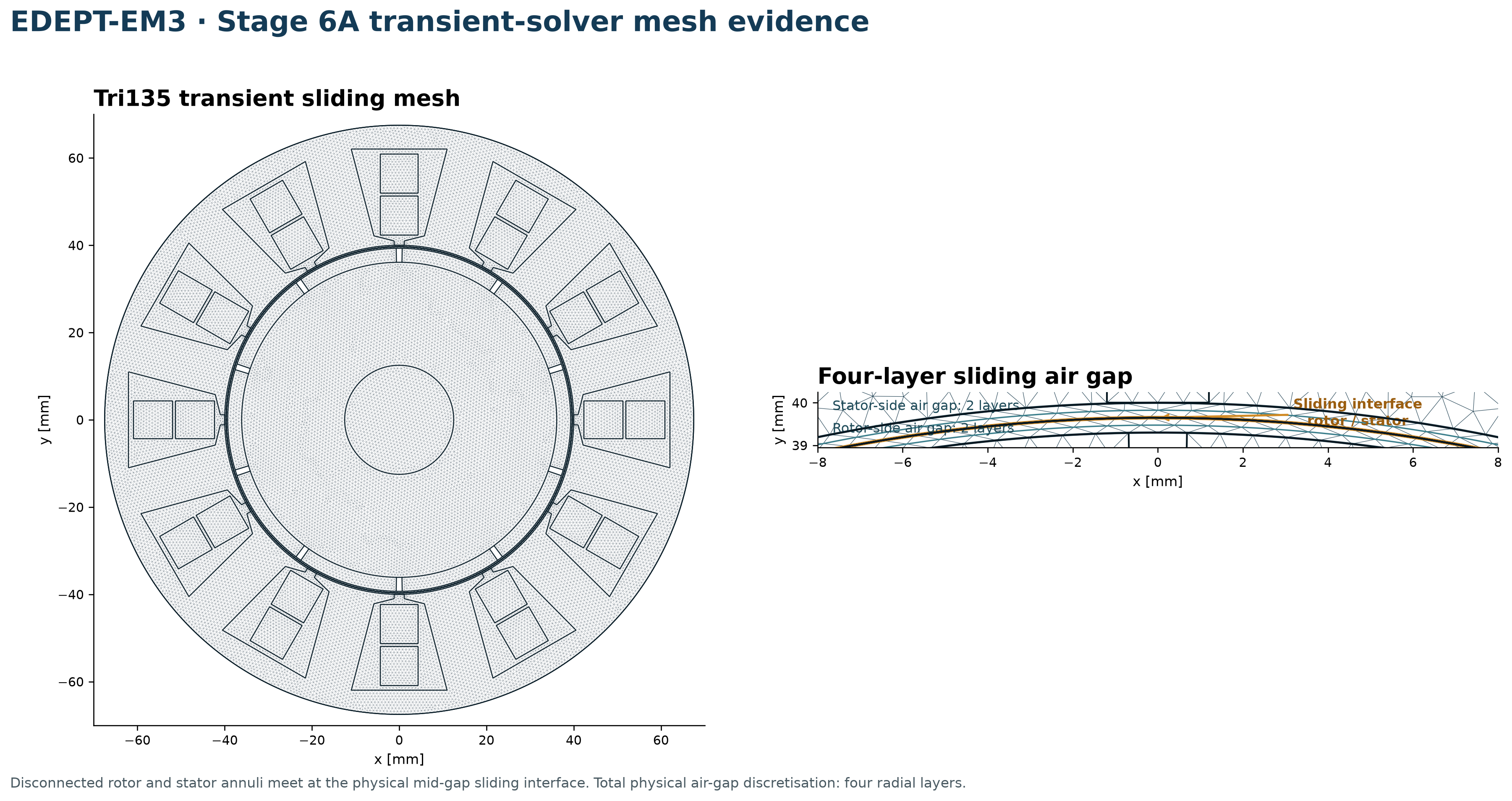
The Tri135 transient solver uses two rotor-side layers and two stator-side layers meeting at the disconnected physical mid-gap sliding interface.
View full resolution ↗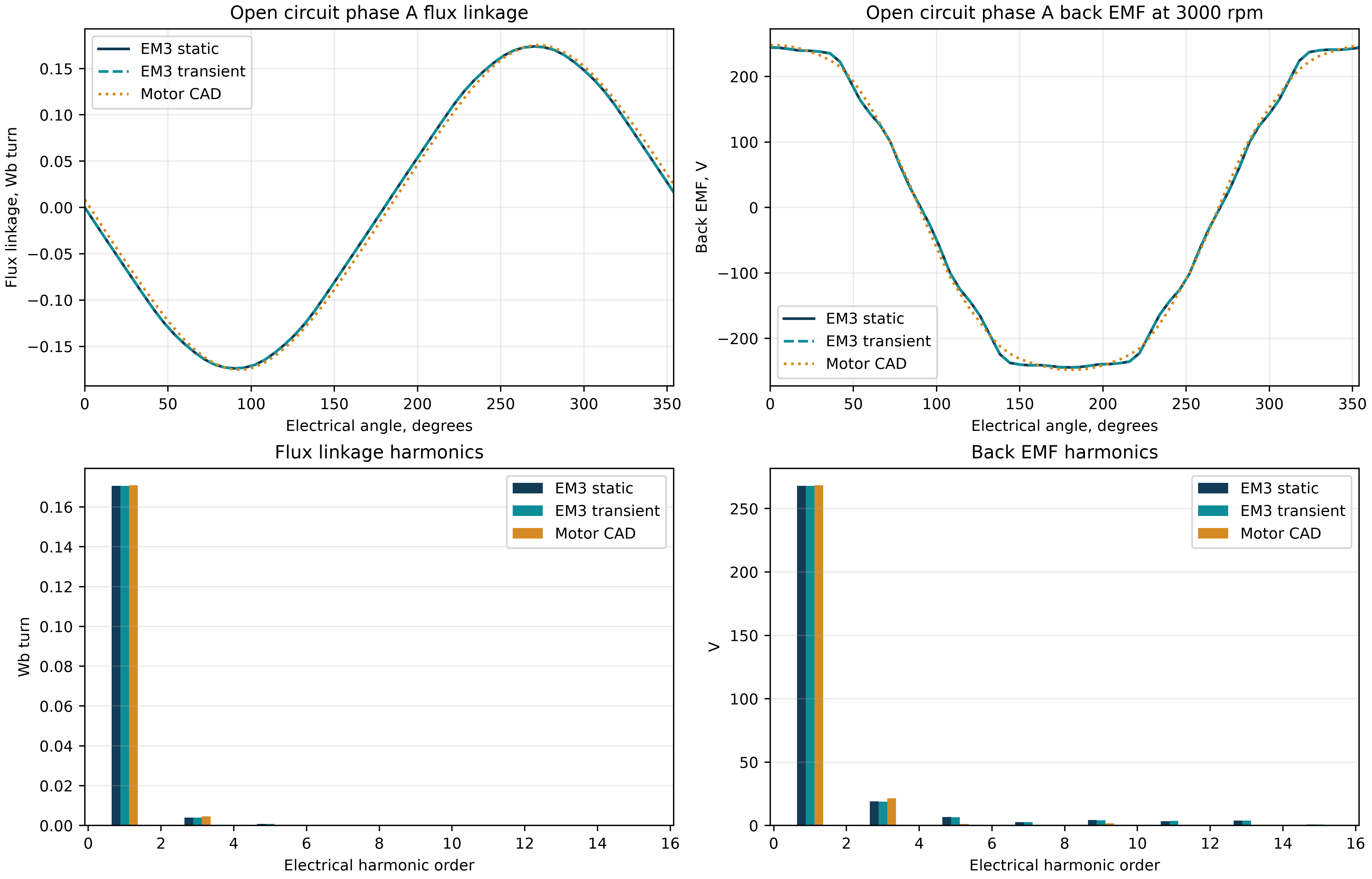
EM3 static, EM3 transient and Motor-CAD flux-linkage and back-EMF waveforms are compared on one governed basis.
View full resolution ↗At 3000 rpm, this historical Tri135 open-circuit back-EMF fundamental comparison recorded 189.41 V RMS for EM3 static, 189.48 V RMS for EM3 transient and 189.71 V RMS for Motor-CAD.
DEFINE · MESH · SOLVE · CORRELATE · GOVERN